Listen to this reflection
At age 24 I was married, a college graduate and working as a journalist at a newspaper in Morgantown, West Virginia. I felt accomplished.
By the same age, St. Elizabeth of Hungary had married Prince Louis IV of Thuringia, birthed three children, spent years serving the poor, established a hospital where she helped to care for the ill and dying, was widowed, outcast from her husband’s royal family, lived in extreme poverty, and then became a member of the Franciscan Third Order (known today as the Secular Franciscans). And, at this young age she died – most likely due to the austere conditions she imposed upon herself while caring for the poor.
St. Elizabeth’s obituary reads as if she had lived 70 or 80 years. Her royal lineage holds many fascinating stories, each of which could be explored endlessly, but it is her short, highly productive religious life that I find myself returning to time and time again. How, by the age of 24, did she accomplish what she did? What 24-year-old establishes hospitals and becomes the patron saint of a religious order?
The facts of her life were recorded by her spiritual director and her handmaidens and submitted to Pope Gregory IX for her canonization. In these documents it was said of her: “Like a stream of living water, she refreshed the thirsty, clothed the naked, and was a mother to the poor.”
In today’s Gospel reading, Jesus stays at the house of the wealthy tax collector Zacchaeus, who is so moved by this love that he promises to give half of his possessions to the poor. The people are shocked that Jesus affiliates with this reviled man. Jesus’ actions change how they see salvation. St. Elizabeth’s service to the poor shocked the people of Thuringia at first as well, but it moved her husband to support her radical devotion to the Gospel and left a legacy of spiritual inspiration.
In today’s first reading from Revelation, John warns of the dangers of being lukewarm. “So, because you are lukewarm, neither hot nor cold, I will spit you out of my mouth.” At age 61, I have far outlived St. Elizabeth of Hungary, yet I fear that so much of my life has been spent on the warming plate.
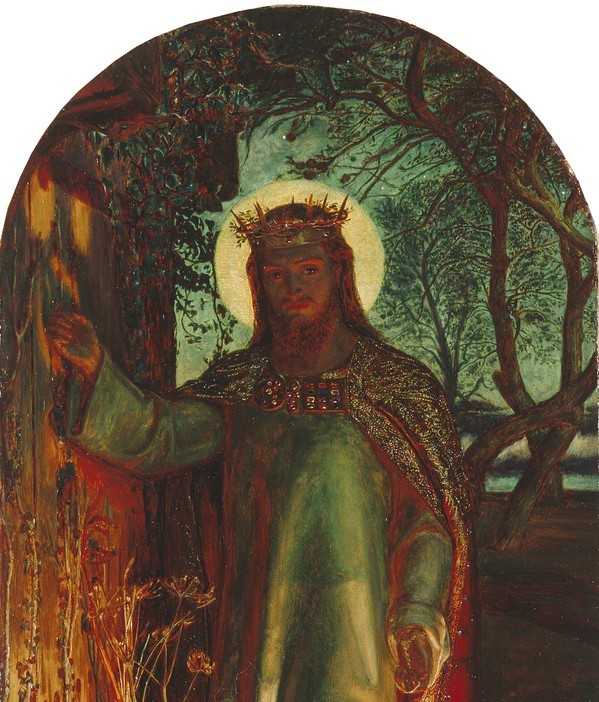
Each day I come downstairs and face our print of the 19th Century painting, The Light of the World, by William Holman Hunt. “Behold, I stand at the door and knock,” Jesus says. Darkness is settling in. Light radiates from around Our Lord and a sliver of it shines from inside the home. If the door is opened, brightness will spill into the world, mingling with the light of our salvation. We then cannot help but be light ourselves.
A los 24 años, ya estaba casada, me había graduado de la universidad y trabajaba como periodista en un periódico de Morgantown, Virginia Occidental. Me sentía dotada.
A esa misma edad, Santa Isabel de Hungría ya se había casado con el príncipe Luis IV de Turingia, había dado a luz a tres hijos, había pasado años sirviendo a los pobres, había fundado un hospital donde ayudaba a cuidar a los enfermos y moribundos, se había quedado viuda, había sido expulsada de la familia real de su esposo, había vivido en la pobreza extrema y se había convertido en miembro de la Tercera Orden Franciscana (conocida hoy como la Orden Franciscana Seglar). Y murió a esa temprana edad, muy probablemente debido a las condiciones austeras que ella misma se imponía mientras cuidaba a los pobres.
La reseña biográfica de Santa Isabel parece la de alguien que hubiera vivido 70 u 80 años. Su linaje real encierra muchas historias fascinantes, cada una de las cuales podría explorarse interminablemente; sin embargo, es a su breve pero sumamente fructífera vida religiosa a la que vuelvo una y otra vez. ¿Cómo logró hacer todo eso a los 24 años? ¿Qué joven de 24 años funda hospitales y se convierte en santa patrona de una orden religiosa?
Los hechos de su vida fueron registrados por su director espiritual y sus doncellas, y presentados al Papa Gregorio IX para su canonización. En dichos documentos se decía de ella: “Como un torrente de agua viva, refrescaba al sediento, vestía al desnudo y era madre para los pobres”.
En la lectura del Evangelio de hoy, Jesús se aloja en casa del rico recaudador de impuestos Zaqueo, quien se siente tan conmovido por este amor que promete dar la mitad de sus bienes a los pobres. La gente se escandaliza de que Jesús se relacione con un hombre tan detestado. Las acciones de Jesús transforman la manera en que perciben la salvación. El servicio de Santa Isabel a los pobres también causó sorpresa inicial entre la gente de Turingia, pero llevó a su esposo a apoyar su radical devoción al Evangelio y dejó un legado de inspiración espiritual.
En la primera lectura de hoy, tomada del libro del Apocalipsis, Juan advierte sobre los peligros de la tibieza: “Pero porque eres tibio y no eres ni frío ni caliente, estoy a punto de vomitarte de mi boca”. A mis 61 años, he vivido mucho más tiempo que Santa Isabel de Hungría; sin embargo, temo haber pasado gran parte de mi vida en la tibieza.
Cada día bajo la escalera y me encuentro frente a nuestra reproducción del cuadro del siglo XIX “Light of the World” (La luz del mundo), de William Holman Hunt. “Mira, estoy a la puerta y llamo”, dice Jesús. La oscuridad se cierne sobre el entorno. La luz irradia desde la figura de Nuestro Señor y un rayo de ella resplandece desde el interior de la casa. Si se abre la puerta, el resplandor se derramará sobre el mundo, fundiéndose con la luz de nuestra salvación. Entonces, no podremos evitar ser luz nosotros mismos.
 Beth Casteel writes from rural southwestern Pennsylvania. She and her husband are blessed with four adult children and five grandchildren. You can read more of her work at bethcasteel.com or you can check out her chapter in two collaborative books, Crowned With Grace, and Cloud of Witnesses, available at store.
Feature Image Credit: William Holman Hunt, commons.wikimedia.org/wiki/File:Hunt_Light_of_the_World.jpg
The views and opinions expressed in the Inspiration Daily blog are solely those of the original authors and contributors. These views and opinions do not necessarily represent those of Diocesan, the Diocesan staff, or other contributors to this blog.