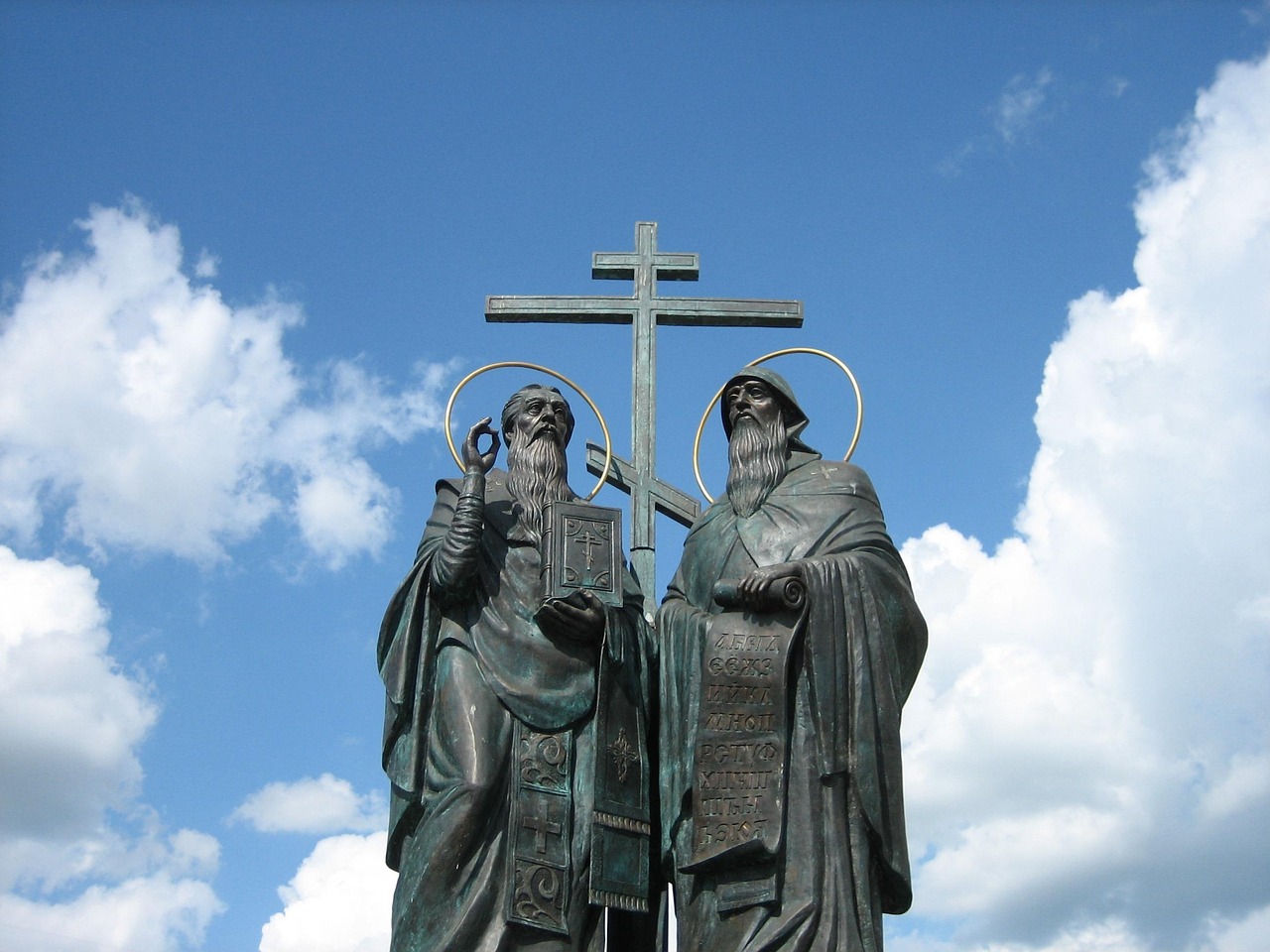
Click here for daily readingsSaints Cyril and Methodius, whose feast day we celebrate today, didn’t mean much to me until I started playing the organ at the church named after them. Like most of the other churches that were built in the late 19th and early 20th centuries in southwestern Pennsylvania, this 120-year-old parish was established to serve the coal mining communities. St. Cyril and Methodius parish served the Slavonic peoples of Slovak, Czech, and Polish descent.
Our towns were forged on the backs of immigrants who came to dig the once-abundant seams of coal that powered the steel mills in Pittsburgh. While most of the coal mines are now closed, the “patch” towns that formed around them still decorate our landscape. Many churches still have remnants of their immigrant heritage. At St. Cyril and Methodius, traditional foods like pierogi (filled dumplings), and haluski (cabbage and noodles), are sold during Lent and a Wigilia (traditional Polish Christmas Eve dinner) is celebrated in Advent.
My maternal and paternal great-grandparents immigrated from Austria, Poland, and Czechoslovakia. They landed north of Pittsburgh where they farmed, worked in the mill and in domestic service. In just two generations, much of their language and culture were lost as children and grandchildren were encouraged to embrace American life.
The church I grew up in and still belong to today – which is just ten minutes from St. Cyril and Methodius – was said to be the “Irish church,” but when my parents settled in this rural community at the foot of the mountains, they became members because it seemed that all were welcome.
I wonder what my ancestors knew of Cyril and Methodius. Probably very little. I struggle to warm up to the images of these two staunch-looking elderly monks. They were born in Thessalonica as Michael (in 815) and Constantine (around 825) but took the religious names of Methodius and Cyril before beginning a missionary journey in 863. It is believed that their mother was of Slavic descent and therefore they were familiar with the language. Well educated, they took on significant translations. Cyril composed a Slavonic alphabet and Methodius contributed to the translation of the liturgy and Scripture.
Like Our Lord, who “dismissed the crowd and got into the boat with his disciples and came to the region of Dalmanutha,” Cyril and Methodius traveled to unknown lands, their legacy casting across the sea to the foreigners who settled the Americas. May we follow their example by proclaiming the Good News to those we come into contact with each day.
Santos Cirilo y Metodio, cuya fiesta celebramos hoy, no significaron mucho para mí hasta que comencé a tocar el órgano en la iglesia que lleva su nombre. Como la mayoría de las iglesias construidas a finales del siglo XIX y principios del XX en el suroeste de Pensilvania, esta parroquia que tiene 120 años se fundó para servir a las comunidades mineras de carbón. La parroquia de Santos Cirilo y Metodio servía a los pueblos eslavos de ascendencia eslovaca, checa y polaca.
Nuestros pueblos se forjaron gracias a los inmigrantes que llegaron a extraer las abundantes vetas de carbón que alimentaban las acerías de Pittsburgh. Si bien la mayoría de las minas de carbón están cerradas, los pueblos que se formaron a su alrededor aún adornan nuestro paisaje. Muchas iglesias aún conservan tradiciones de su herencia inmigrante. En la iglesia de Santos Cirilo y Metodio, se venden comidas tradicionales como pierogi (empanadillas rellenas) y haluski (col y fideos) durante la Cuaresma, y en Adviento se celebra una Wigilia (cena tradicional polaca de Nochebuena).
Mis bisabuelos maternos y paternos emigraron de Austria, Polonia y Checoslovaquia. Llegaron al norte de Pittsburgh, donde se dedicaron a la agricultura, trabajaron en el molino y en el servicio doméstico. En tan solo dos generaciones, gran parte de su lengua y cultura se perdió porque se animaba a hijos y nietos a adoptar la vida estadounidense.
La iglesia en la que crecí y a la que sigo perteneciendo, que está a solo diez minutos de Santos Cirilo y Metodio, se decía que era la “iglesia irlandesa”, pero cuando mis padres se establecieron en esta comunidad rural al pie de las montañas, se hicieron miembros porque parecía que todos eran bienvenidos.
Me pregunto qué sabían mis antepasados de Cirilo y Metodio. Probablemente muy poco. Me cuesta aceptar la imagen de estos dos monjes ancianos de aspecto firme. Nacieron en Tesalónica como Miguel (en 815) y Constantino (alrededor de 825), pero adoptaron los nombres religiosos de Metodio y Cirilo antes de emprender un viaje misionero en 863. Se cree que su madre era de ascendencia eslava, por lo que dominaban el idioma. Con una buena educación, se encargaron de importantes traducciones. Cirilo compuso un alfabeto eslavo y Metodio contribuyó a la traducción de la liturgia y las Escrituras.
Al igual que Nuestro Señor, quien “se embarcó con sus discípulos y llegó a la región de Dalmanuta”, Cirilo y Metodio viajaron a tierras desconocidas, dejando su legado hasta el otro lado del océano a los extranjeros que se mudaron a las Américas. Que sigamos su ejemplo proclamando la Buena Nueva a diario a quienes nos rodean.
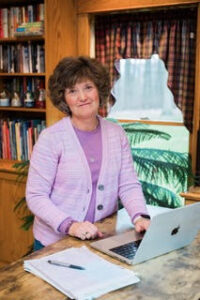 Beth Casteel writes from rural southwestern Pennsylvania. She and her husband are blessed with four adult children and four grandchildren. You can read more of her work at https://bethcasteel.com/ or you can check out her chapter in two collaborative books, Crowned With Grace, and Cloud of Witnesses, available at https://store.
Feature Image Credit: intererra, pixabay.com/photos/the-statue-kolomna-2171097/
The views and opinions expressed in the Inspiration Daily blog are solely those of the original authors and contributors. These views and opinions do not necessarily represent those of Diocesan, the Diocesan staff, or other contributors to this blog.