Listen to this reflection
The saraph serpents are hurting and killing people with their fiery bite. And while the people deserved this punishment for their complaining and their ingratitude to God for freeing them from slavery, God also provided a remedy for them once they had owned their sin and repented. The remedy was a strange one: if they looked at the bronze serpent lifted up on a pole, they would live. They had to look up with faith to the very thing that was hurting them. And they would live.
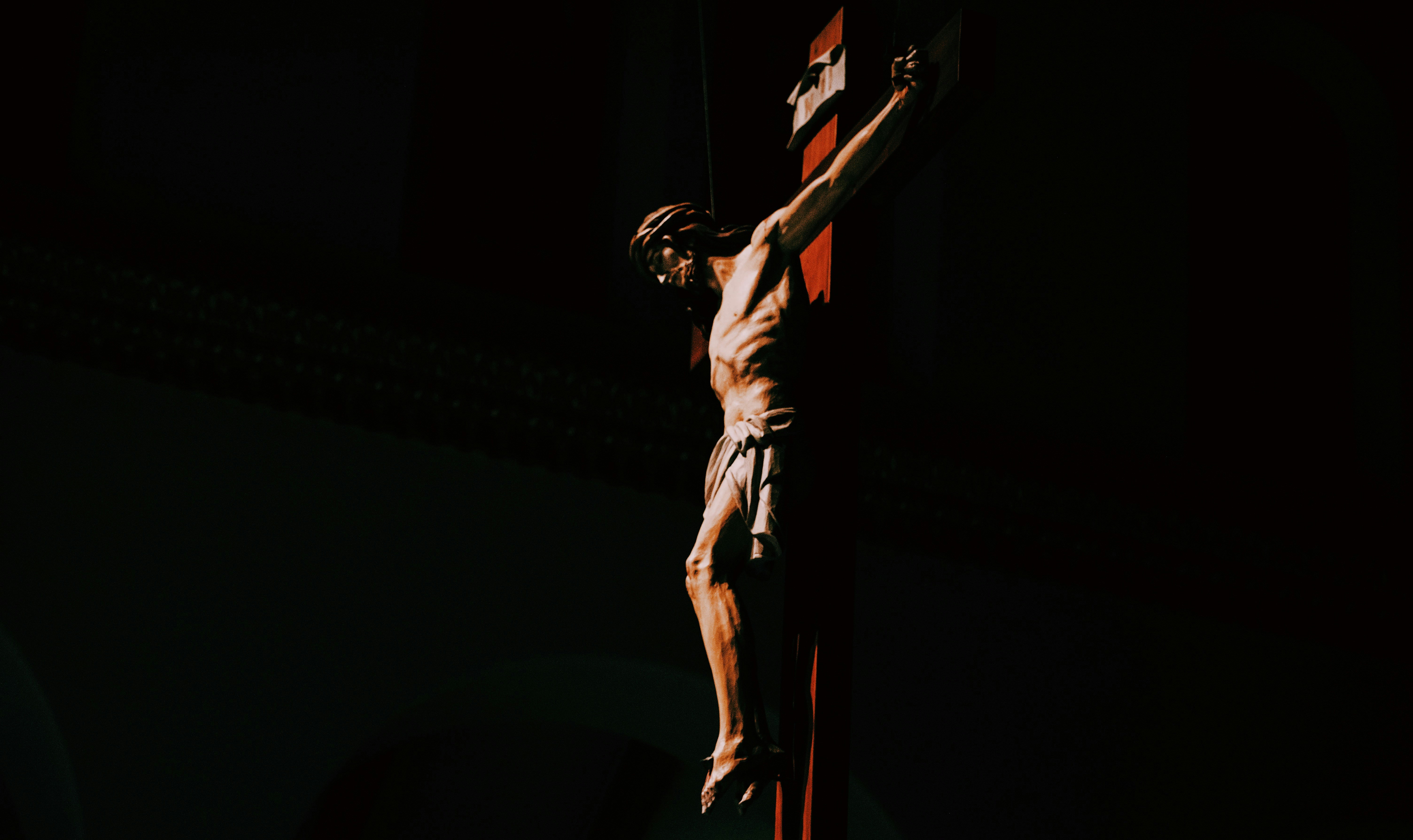
On this Feast of the Exaltation of the Cross, we are shown the parallel between the situation described in the book of Numbers and our own situation. Jesus explains to Nicodemus that the Son of Man must be lifted up like the serpent in the desert, so that all who believe in him “might not perish but might have eternal life.”
Jesus has come to save us from our slavery to sin and self. When we give into sin and selfishness, we are perishing. But if we will repent of our sin and ingratitude and look on the Cross of Christ with faith, we are given life. Because Jesus took “the form of a slave” and “became sin” (2 Cor 5:21) for us, so that we could see in his Passion how sin disfigures and drains away life, and we must not look away. We have to look up with faith to the Cross to see what sin looks like. And we will live.
The typology is clear, but whenever typology is fulfilled, it is also deepened. The bronze serpent was an image of both the sin and the punishment, but it was only an image. Jesus was born “in human likeness,” (Phil 2:7) and though he knew no sin he “became sin” for us, bearing the actual poison and overcoming the root problem itself. In both cases, it is the power of God that saves.
In the cross, death is conquered by death, the curse becomes the cure, apparent defeat is true victory, shame is turned into glory. As the serpent became a sign of healing, the cross of execution became the Tree of Life.
On this day, since the 600’s, the Church has commemorated three things: the finding of the True Cross by St. Helena (Constantine’s mother), the date when the relic of the Cross was first shown publicly for veneration after the consecration of the Basilica of the Holy Sepulchre in 335, and the elevation of the True Cross at Hagia Sophia in 629 after it had been taken back from the Persians. The long history of this feast shows the rich tradition and the profound spiritual meaning we give to the Cross of Christ, the means of our salvation.
We adore you, O Christ, and we bless you, because by your holy Cross you have redeemed the world.
Las serpientes venenosas están hiriendo y matando a las personas con su mordedura de fuego. Y aunque el pueblo merecía este castigo por sus quejas y su ingratitud hacia Dios por haberlos liberado de la esclavitud, Dios también les proveyó un remedio una vez que reconocieron su pecado y se arrepintieron. El remedio era singular: si miraban a la serpiente de bronce alzada en un palo, vivirían. Debían alzar la vista con fe hacia aquello mismo que los estaba hiriendo. Y vivirían.
En esta Fiesta de la Exaltación de la Santa Cruz, se nos muestra el paralelismo entre la situación descrita en el libro de los Números y nuestra propia situación. Jesús explica a Nicodemo que el Hijo del Hombre debe ser alzado, tal como la serpiente en el desierto, para que todo aquel que crea en él “no perezca, sino que tenga vida eterna”.
Jesús ha venido para salvarnos de nuestra esclavitud al pecado y al propio yo. Cuando cedemos ante el pecado y el egoísmo, estamos pereciendo. Pero si nos arrepentimos de nuestro pecado y nuestra ingratitud, y miramos con fe hacia la Cruz de Cristo, se nos concede la vida. Porque Jesús tomó “la forma de esclavo” y “se hizo pecado” (2 Co 5,21) por nosotros, para que pudiéramos ver en su Pasión cómo el pecado desfigura y agota la vida; y no debemos apartar la mirada. Debemos alzar la vista con fe hacia la Cruz para ver como se ve el pecado. Y viviremos.
La tipología es clara; sin embargo, cada vez que una tipología se cumple, también se profundiza. La serpiente de bronce era una imagen tanto del pecado como del castigo, pero era solo una imagen. Cuando Jesús nació “se hizo semejante a los hombres” (Fil 2,7) y, aunque no conoció el pecado, “se hizo pecado” por nosotros, cargando con el veneno real y superando la raíz misma del problema. En ambos casos, es el poder de Dios el que salva.
En la Cruz, la muerte es vencida por la muerte; la maldición se convierte en cura; la aparente derrota es verdadera victoria; la vergüenza se transforma en gloria. Así como la serpiente se convirtió en signo de sanación, la cruz de la ejecución se convirtió en el Árbol de la Vida.
En este día, desde el siglo VII, la Iglesia ha conmemorado tres acontecimientos: el hallazgo de la Vera Cruz por Santa Elena (madre de Constantino), la fecha en que la reliquia de la Cruz fue expuesta públicamente por primera vez para su veneración tras la consagración de la Basílica del Santo Sepulcro en el año 335, y la elevación de la Verdadera Cruz en Santa Sofía en el año 629, después de haber sido recuperada de los persas. La larga historia de esta fiesta pone de manifiesto la rica tradición y el profundo significado espiritual que atribuimos a la Cruz de Cristo, instrumento de nuestra salvación.
Te adoramos, oh Cristo, y te bendecimos, porque por tu santa Cruz has redimido al mundo.
 Kathryn Mulderink, MA, is married to Robert, Station Manager for Holy Family Radio. Together they have seven children (including Father Rob), and eleven grandchildren. She is President of the local community of Secular Discalced Carmelites and has published five books and many articles. Over the last 30 years, she has worked as a teacher, headmistress, catechist, Pastoral Associate, and DRE, and as a writer and voice talent for Catholic Radio. Currently, she serves the Church by writing and speaking, and by collaborating with various parishes and to lead others to encounter Christ and engage their faith. Her website is KathrynTherese.com
Feature Image Credit: Gianna B, unsplash.com/photos/a-statue-of-a-man-on-a-cross-in-the-dark-s_4upDDvG3g
The views and opinions expressed in the Inspiration Daily blog are solely those of the original authors and contributors. These views and opinions do not necessarily represent those of Diocesan, the Diocesan staff, or other contributors to this blog.