Listen to this reflection
Word was spreading and people everywhere were talking about Jesus. Who was He? He is somehow John the Baptist. No, He’s Elijah. No, Jeremiah. No, He’s a prophet. Ancient us, modern us…are we really that different? We’re still arguing. Jesus was a prophet; Jesus was God but not really man; Jesus was man but not really God; Jesus was just a really nice guy that lived a long time ago.
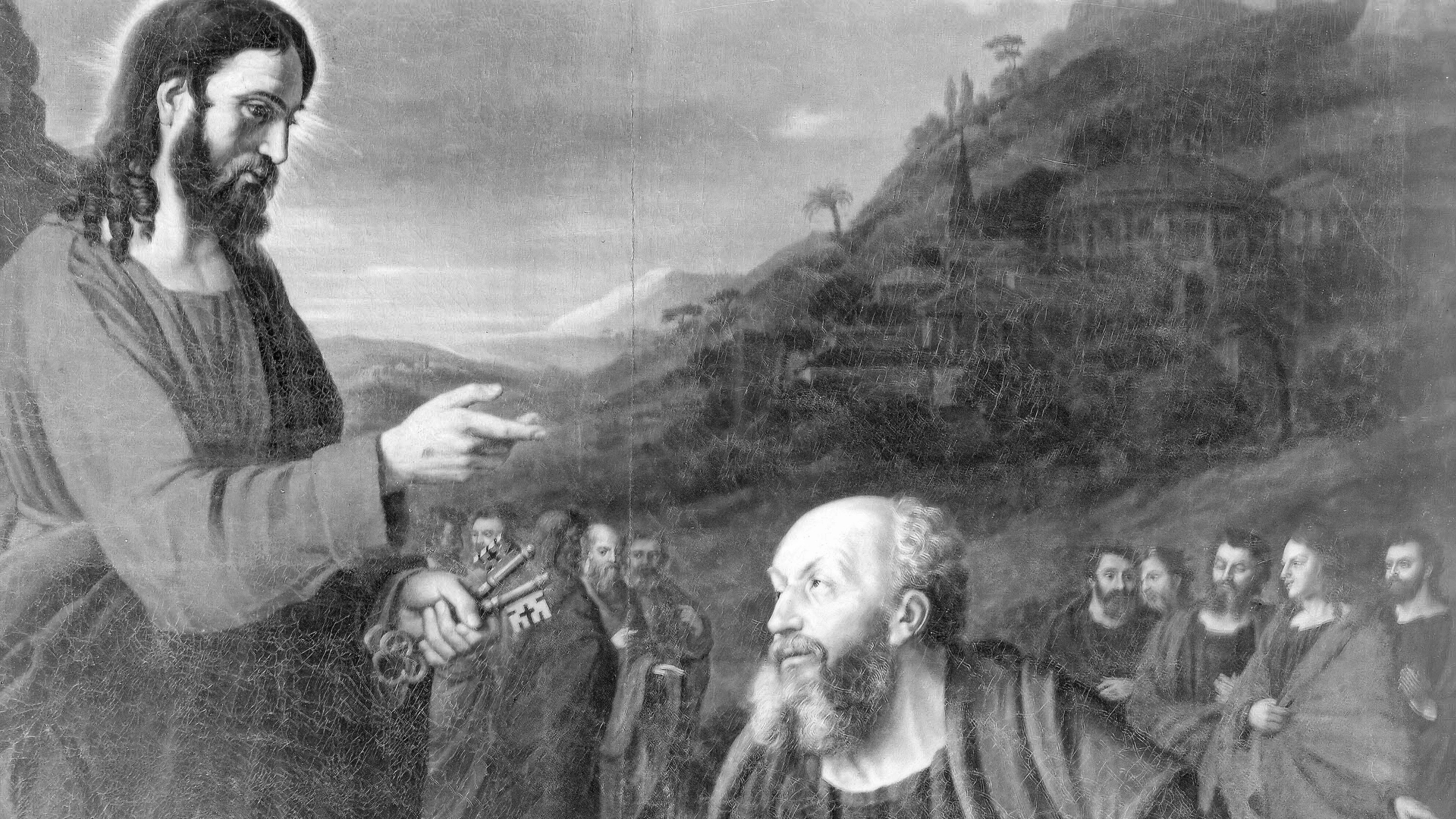
Who is Jesus? Peter knew. Jesus is “the Christ, the Son of the living God.” “Blessed are you, Simon son of Jonah. For flesh and blood has not revealed this to you, but my heavenly Father.”
God knows us so well. He knew that the years leading up to His second coming would be much like the final days of His first: full of disputes, disagreements, debates, each participant certain of his own position. Who do we believe? How do we know what’s true? God knew we needed an authority to trust, so through his Son, He left us a gift – the Papacy.
When Jesus promised that Peter would be our rock, our authority, he became our first Pope, and we can trace that line of authority from Peter right up to Pope Leo XIV today. We look to the chair of Peter not because he himself was so wise but rather because God promised to reveal Truth to this chair, and God keeps His promises.
Throughout the centuries, saints, including Peter, have filled that Holy Chair, but so have imperfect, even corrupt, men. Still, the Chair and the Church endure. As He promised, “the gates of the netherworld shall not prevail against it,” and God’s promises will always triumph over the lies of man.
We don’t trust the authority of the Church because the guys in charge of it are perfect, but rather because He who established it is indeed perfect. Our ever-faithful God promised that the successors of Peter would hold Truth. It’s not the man himself who is infallible but rather the position, the Holy Chair, the Holy See. When our Popes speak “ex cathedra,” from the chair, to the Universal Church on issues of faith and morals, we believe that he is being guided by the Holy Spirit and cannot make a mistake. That is God’s promise, and that is why we can look to the Holy See and trust it.
Not only can we trust our Holy Father’s authority, but also are we called to, especially when that wisdom challenges our own. It is not a blind following that ignores or dismisses the missteps of man. Instead, it is a humble following that recognizes an eternal wisdom, understanding, and authority greater than our own. Why did Jesus leave us our Church, our Pope, our earthly authority? Because he knows us so well.
La noticia se difundía y la gente, por doquier, hablaba de Jesús. ¿Quién era Él? De algún modo, es Juan el Bautista. No, es Elías. No, Jeremías. No, es un profeta. La gente de los tiempos pasados, la gente moderna… ¿somos realmente tan distintos? Seguimos discutiendo. Jesús era un profeta; Jesús era Dios, pero no verdaderamente hombre; Jesús era hombre, pero no verdaderamente Dios; Jesús era simplemente un tipo muy amable que vivió hace mucho tiempo.
¿Quién es Jesús? Pedro sabía quién era. Jesús es “el Mesías, el Hijo de Dios vivo”. “¡Dichoso tú, Simón, hijo de Juan, porque esto no te lo ha revelado ningún hombre, sino mi Padre, que está en los cielos!”
Dios nos conoce muy bien. Él sabía que los años previos a su segunda venida serían muy semejantes a los últimos días de la primera: llenos de disputas, desacuerdos y debates, con cada participante convencido de la validez de su propia postura. ¿A quién le creemos? ¿Cómo sabemos qué es verdad? Dios sabía que necesitábamos una autoridad en la que confiar; por ello, a través de su Hijo, nos dejó un regalo: el Papado.
Cuando Jesús prometió que Pedro sería nuestra roca, nuestra autoridad, este se convirtió en nuestro primer Papa; y podemos rastrear esa línea de autoridad desde Pedro hasta el Papa actual. Dirigimos nuestra mirada a la Cátedra de Pedro no porque él mismo fuera tan sabio, sino más bien porque Dios prometió revelar la Verdad a través de esta Cátedra, y Dios cumple sus promesas.
A lo largo de los siglos, santos —incluido Pedro— han ocupado esa Santa Cátedra; pero también lo han hecho hombres imperfectos, e incluso corruptos. Aun así, la Cátedra y la Iglesia perduran. Tal como Él prometió: “las puertas del infierno no prevalecerán contra ella”; y las promesas de Dios siempre triunfarán sobre las mentiras del hombre.
No confiamos en la autoridad de la Iglesia porque quienes la dirigen sean perfectos, sino más bien porque Aquel que la instituyó es perfecto. Nuestro Dios, siempre fiel, prometió que los sucesores de Pedro custodiarían la Verdad. No es el hombre en sí mismo quien es infalible, sino la posición, la Santa Cátedra, la Santa Sede. Cuando nuestros Papas hablan *ex cathedra* —desde la cátedra— a la Iglesia universal sobre cuestiones de fe y moral, creemos que están siendo guiados por el Espíritu Santo y que no pueden equivocarse. Esa es la promesa de Dios, y por ello podemos dirigir nuestra mirada a la Santa Sede y confiar en ella.
No solo podemos confiar en la autoridad de nuestro Santo Padre, sino que también estamos llamados a hacerlo, especialmente cuando esa sabiduría desafía la nuestra. No se trata de un seguimiento ciego que ignora o desestima los errores humanos; por el contrario, es un seguimiento humilde que reconoce una sabiduría, una comprensión y una autoridad eternas, superiores a las nuestras. ¿Por qué nos dejó Jesús nuestra Iglesia, nuestro Papa, nuestra autoridad terrenal? Porque nos conoce muy bien.
 Pamela Kavanaugh is a grateful wife, mother, and grandmother who has dedicated her professional life to Catholic education. Though she has done her very best to teach her students well in the subjects of language and religion, she knows that she has learned more than she has taught. She lives, teaches, and writes in southwest suburban Chicago.
Feature Image Credit: Artist Unknown, https://art.diocesan.com/stock-photo/christ-hands-over-the-keys-to-st-peter-25209/
The views and opinions expressed in the Inspiration Daily blog are solely those of the original authors and contributors. These views and opinions do not necessarily represent those of Diocesan, the Diocesan staff, or other contributors to this blog.