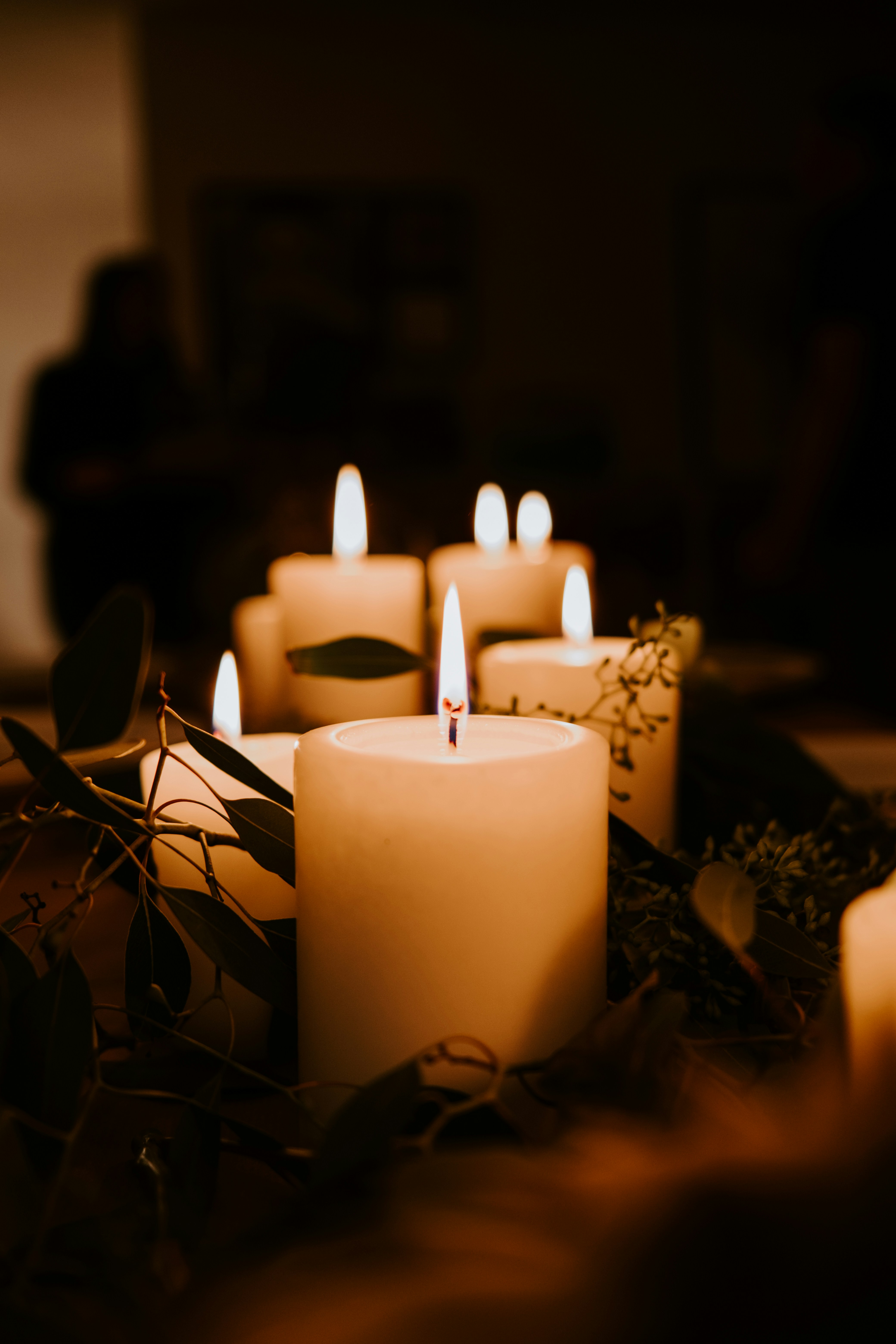
Candles are often-undervalued. Candlelight is warm, cozy, organic, relaxing, quieting. Beeswax candles smell wonderful and are good for your environment (my Scandinavian side values the tradition of “hygge,” in which candles are a must). In Danish, candles are called “levende lys”, which literally means “living light.” There is something mystical about candlelight, its deep naturalness, the continuity throughout time, the connection to bees.
What does any of this have to do with today’s feast? On this day, candles are a prominent feature in the liturgy – lit candles may be carried in procession and candles are blessed on this day because lit candles are used in the Church to symbolize Christ, the true Light who came into the world for all. Today is the day that the Light of the World enters His Temple anew, at last.
In complete humility and obedience to the Law, Joseph and Mary come to the Temple after 40 days to offer the required sacrifice for their firstborn son. As they enter, they are fulfilling the prophecy of Malachi: “And suddenly there will come to the temple the Lord whom you seek.”
The Chosen People had been promised a Messiah, and the identity of the whole Jewish nation was a people who awaited his coming, to set them free from Roman rulers and restore Israel as an eternal, peaceful kingdom. Many expected a warrior who would defeat Israel’s enemies and restore the glory of their nation, as King David’s descendent.
It would require a very deep spirituality to look upon this little infant being carried into the Temple by his impoverished parents and see not only the Messiah, but the Light OF THE WORLD – a light for the Gentiles as well as the Jews. It is only the aged Simeon and Anna who recognize this seemingly ordinary child as the Messiah, the very King of Glory, for whom they had patiently waited in prayer for so long.
In Simeon, the Old and New Testaments meet: as he sees the One who will proclaim that He Himself is the New Temple carried into the old temple, the aged man of the Old Covenant becomes a Christian, and Christianity’s first prophet and theologian, as he proclaims, “my eyes have seen your salvation…. a light for revelation to the Gentiles, and glory for your people Israel.”
In the Church, the great paschal candle represents Christ, the “true light”, a lit candle in the sanctuary indicates that Christ is present in the tabernacle, candles are required at every Mass, at funerals and baptisms. We light them to honor God, to symbolize our sacrifice and our prayer, and to remind us that Christ is our light.
We are not a people of darkness, but of LIGHT! Today, have some candles blessed, light some candles in your home and wherever you pray, and remember that God’s work of creation began with the command, “Let there be light!”
Las velas suelen ser poco valoradas. La luz de las velas es cálida, acogedora, natural, relajante y tranquilizadora. Las velas de cera de abeja huelen de maravilla y son buenas para el ambiente (mi lado escandinavo valora la tradición del “hygge”, en la que las velas son imprescindibles). En danés, las velas se llaman “levende lys”, que literalmente significa “luz viva”. Hay algo místico en la luz de las velas: su profunda naturalidad, su continuidad a través del tiempo, su conexión con las abejas.
¿Qué tiene que ver todo esto con la festividad de hoy? En este día, las velas son un elemento destacado de la liturgia: se pueden llevar velas encendidas en procesión y se bendicen porque en la Iglesia se usan para simbolizar a Cristo, la Luz verdadera que vino al mundo para todos. Hoy es el día en que la Luz del Mundo entra de nuevo en su Templo, por fin. Con total humildad y obediencia a la Ley, José y María acudieron al Templo después de 40 días para ofrecer el sacrificio requerido por su primogénito. Al entrar, cumplieron la profecía de Malaquías: “De improviso entrará en el santuario el Señor, a quien ustedes buscan”.
Al Pueblo Elegido se le había prometido un Mesías, y la identidad de toda la nación judía era la de un pueblo que esperaba su venida para liberarlos de los gobernantes romanos y restaurar a Israel como un reino eterno y pacífico. Muchos esperaban un guerrero que derrotaría a los enemigos de Israel y restauraría la gloria de su nación, como descendiente del rey David.
Se requeriría una espiritualidad muy profunda para contemplar a este pequeño bebé llevado al Templo por sus padres empobrecidos y ver no solo al Mesías, sino a la Luz del mundo: una luz tanto para los gentiles como para los judíos. Solo los ancianos Simeón y Ana reconocieron a este niño aparentemente común como el Mesías, el mismísimo Rey de la Gloria, por quien habían esperado pacientemente en oración durante tanto tiempo.
En Simeón, el Antiguo y el Nuevo Testamento se unen: al ver a Aquel que proclamará que Él mismo es el Nuevo Templo, llevado al antiguo templo, el anciano (Simeón) de la Antigua Alianza se convierte en cristiano, y en el primer profeta y teólogo del cristianismo, al proclamar: “mis ojos han visto a tu Salvador… luz que alumbra a las naciones y gloria de tu pueblo, Israel”.
En la Iglesia, el gran cirio pascual representa a Cristo, la “luz verdadera”. Una vela encendida en el santuario indica que Cristo está presente en el tabernáculo. Se requieren velas en cada misa, en los funerales y en los bautizos. Las encendemos para honrar a Dios, para simbolizar nuestro sacrificio y nuestra oración, y para recordarnos que Cristo es nuestra luz.
¡No somos un pueblo de tinieblas, sino de LUZ! Hoy, bendigan algunas velas, enciéndanlas en su hogar y dondequiera que recen, y recuerden que la obra creadora de Dios comenzó con el mandato: “¡Que haya luz!”
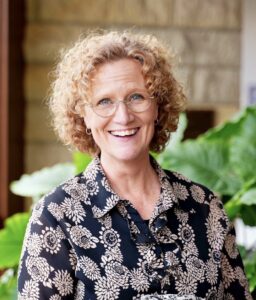 Kathryn Mulderink, MA, is married to Robert, Station Manager for Holy Family Radio. Together they have seven children (including Father Rob), and eleven grandchildren. She is President of the local community of Secular Discalced Carmelites and has published five books and many articles. Over the last 30 years, she has worked as a teacher, headmistress, catechist, Pastoral Associate, and DRE, and as a writer and voice talent for Catholic Radio. Currently, she serves the Church by writing and speaking, and by collaborating with various parishes and to lead others to encounter Christ and engage their faith. Her website is www.KathrynTherese.comFeature
Image Credit: Claudio Schwarz, https://unsplash.com/photos/white-pillar-candles-on-black-holder-e7cDMN6f0gs
The views and opinions expressed in the Inspiration Daily blog are solely those of the original authors and contributors. These views and opinions do not necessarily represent those of Diocesan, the Diocesan staff, or other contributors to this blog.