
This Gospel is the Annunciation to Joseph. We are dealing with the greatest mystery to ever happen on earth: the Incarnation of the Lord, that God became a man. Before this mystery, we have to put aside our human way of thinking and ponder the mystery of God. The most common interpretation of this passage is that Joseph thought that Mary was at fault in some way. Knowing her goodness, he didn’t know what to make of it and tried to protect her. But there is another interpretation, less commonly held, but well grounded in the text. This ancient tradition is found in the writings of some Fathers and Doctors of the Church* and brings out the greatness and holiness of Saint Joseph.
Joseph was a “just” (dikaios) man. While that might suggest someone who observed the Law, it’s more than that. It means that a person is just before God, like the great saints of the Old Testament, who loved God and followed his will. This attitude of being just before God is expressed in a holy fear before the Lord, a reverence before the mystery. When Moses saw the burning bush and heard God say, “the place on which you are standing is holy ground . . . “Moses hid his face, for he was afraid to look at God” (Ex 3:5-6). So too the prophet Isaiah, when he saw the Lord, cried out, “Woe is me! I am lost, for I am a man of unclean lips…yet my eyes have seen the King, the Lord of hosts!” (Is 6:5) Then the Lord cleansed him and sent him on his prophetic mission.
Joseph received a mission in his Annunciation. Although the way this Gospel is translated seems to imply something negative, it can be translated as to mean that Joseph felt himself unworthy to reveal the mystery worked in Mary, so he decided to secretly separate himself from her. Perhaps Mary told him what happened. Or maybe the Holy Spirit enlightened him so that he knew that God was at work in Mary.
Saint Thomas Aquinas held this opinion: “Joseph was minded to put away the Blessed Virgin not because he suspected her of fornication, but because in reverence for her sanctity, he feared to cohabit with her” (Summa Th., Supplement, q. 62, article 3, reply 4). Saint Bernard also testifies: “Joseph’s reason was the same as Peter’s when he said, ‘Depart from me, for I am a sinful man, O Lord,’ and that of the centurion when he exclaimed, ‘I am not worthy that you should enter under my roof.’ Joseph looked on himself as a sinner and as unworthy to entertain one in whom he beheld a superhuman dignity. He beheld with awe in the Virgin-Mother a certain sign of the Divine Presence” (Homily, Super missus est, II, 14).
The angel tells Joseph “do not be afraid,” just as Gabriel said to Mary, and just as the Lord told so many holy people in Israel. The angel tells Joseph that even though he is before this tremendous mystery of God and rightly fears his own unworthiness, he should not be afraid to enter into the mystery. This interpretation puts Joseph squarely in the line of the great saints in the history of Israel. Just as God called Moses, Isaiah, Jeremiah and all the others, despite their human frailties, God called Joseph to play an important part in the mystery of the Incarnation. With reverence for the mystery of God, Joseph said yes. He “did as the angel of the Lord had commanded him.”
Each of us also has a mission from God, a role to play in the great mystery of Jesus Christ and his Church. We may feel ourselves unworthy–why would God call me? But like Joseph, we too can respond with a heartfelt yes. Whatever our vocation, God calls us and can work through us to spread the Gospel and witness to Jesus. That is the mystery of Advent and Christmas.
Saint Joseph, pray for us, that like you we too may respond with joy to the Lord’s call.
Copyright 2017 Daughters of Saint Paul
 Sr. Marianne Lorraine Trouve’ has been a member of the Daughters of Saint Paul since 1976. She has an MA in theology from the University of Dayton and has served on the editorial staff of Pauline Books & Media for over 20 years. She is the author of several books, including Mary: Help in Hard Times and Angels: Help from on High. When she’s not writing, editing, or working on logic puzzles, she can be found blogging at www.thomasfortoday.blogspot
* For an extensive analysis of this interpretation see Ignace de la Potterie, Mary in the Mystery of the Covenant, Alba House, New York, 1992, pp. 37-65. The quotes used are in the public domain. The quote from St Thomas is from the Benziger Brothers’ edition of the Summa. The quote from St Bernard is from Sermons of St Bernard on Advent and Christmas, trans. J.C. Hedley, Benziger Brothers, New York, 1909.
https://archive.org/stream/sermonsofstberna00bernuoft/sermonsofstberna00bernuoft_djvu.txt
 Sr.
Sr. 
 Sr. Kathryn J. Hermes, FSP is a compassionate mentor and guide. Through her writing and online ministry she takes others along with her on her own journey of spiritual transformation, specializing in uncovering in the difficult moments of life where God’s grace is already breaking through. Connect with her website and blog:
 Jeannette de Beauvoir works in the digital department of Pauline Books & Media as marketing copywriter and editor. A graduate of Yale Divinity School, where she studied with Adian Kavanagh, OSB, she is particularly interested in liturgics and Church history.
 Clark Thompson graduated from Franciscan University of Steubenville in 2012 with degrees in Business Administration, Philosophy, and Theology. Baptized in the Christian Reformed Church, he received his sacraments of initiation at Franciscan in 2009. For the last four years he has studied for the Diocese of Kalamazoo, Michigan at both Mundelein Seminary in Chicago and Sacred Heart Major Seminary in Detroit. A list of his notable teachers includes Bishop Robert Barron, Father Emry de Gaál, Dr. John Bergsma, Deacon James Keating, Dr. Mary Healy, and the Chicago Missionaries of Charity sisters with whom he completed a year-long internship.
 During the week, Matt is a mentor for individuals who have developmental and intellectual disabilities. On the weekends, he is a drummer for Full Armor Band.
 Amy Oatley is a wife, mother, and Secular Franciscan (OFS), passionate about social justice, advocating for the dignity of every human life. A writer since elementary school, she currently enjoys freelance writing for diocesan FAITH Magazine and is privileged to work as the RCIA and Adult Faith Formation Coordinator at Our Lady of Consolation parish in Rockford, Michigan.
 Briana is a Catholic Doctrine teacher at Our Lady of Mt. Carmel school in Cleveland, OH. She received her Bachelor of Arts in Theology and Catechetics from the Franciscan University of Steubenville, OH and is excited to use these skills to bring her students closer to Christ and His Church. “My soul has been refined and I can raise my head like a flower after a storm.” -St. Therese
 Noah is a seminarian for the Diocese of Grand Rapids, MI. He received his Bachelors degree in finance and economics from Grand Valley State University. He has a strong devotion to the Blessed Mother and his favorite Saint is St. John Paul II.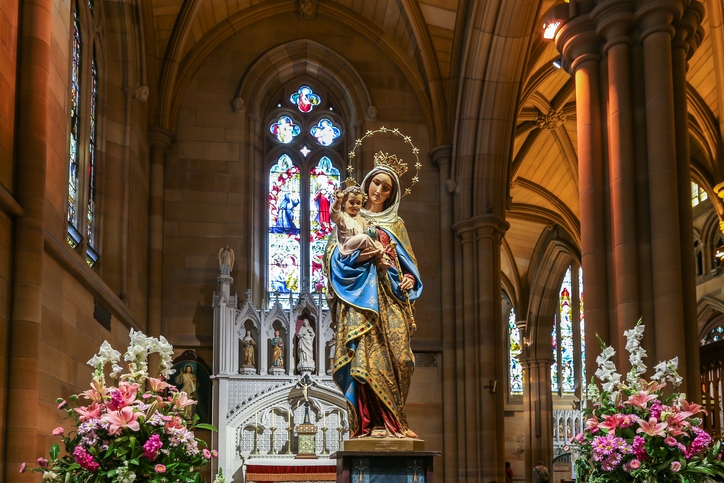
 Damon Owens is the executive director of joytob (joytob.org) and served as the first executive director of the Theology of the Body Institute near Philadelphia. He lives in the Archdiocese of Philadelphia with his wife Melanie and their children – including their “true image of Mary” Veronica Mary celebrates her birthday each year on the Solemnity of the Immaculate Conception!
 Sr. Marianne Lorraine Trouve’ has been a member of the Daughters of Saint Paul since 1976. She has an MA in theology from the University of Dayton and has served on the editorial staff of Pauline Books & Media for over 20 years. She is the author of several books, including Mary: Help in Hard Times and Angels: Help from on High. When she’s not writing, editing, or working on logic puzzles, she can be found blogging at
  1-800-994-9817