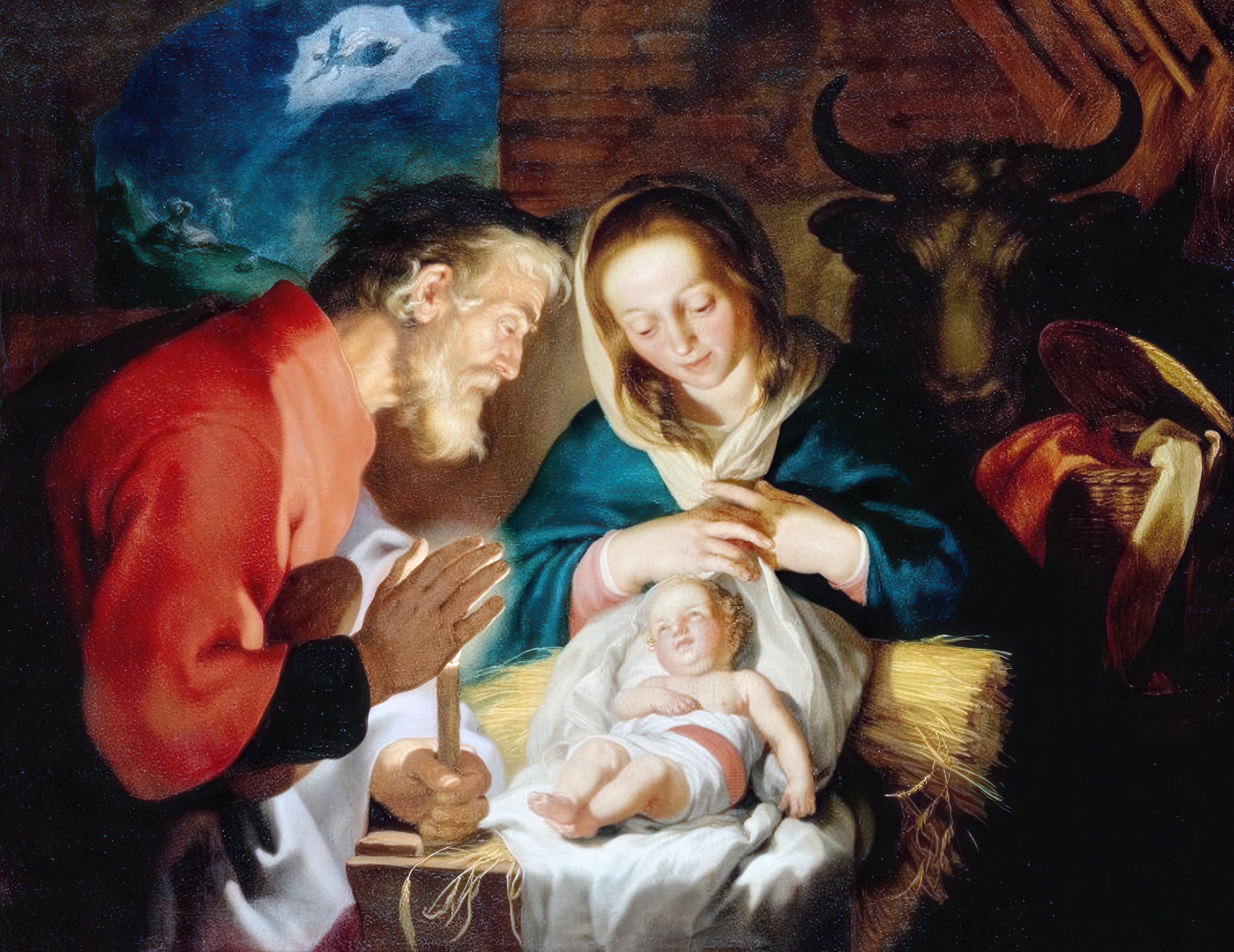
Joy to the world! Today is, as the Church tells us, “The Nativity of our Lord, Jesus Christ”, or what we commonly call “Christmas”. That term comes from an Old English word meaning Christ’s Mass, which is the religious celebration of our Lord’s birth. Christ, of course, is not Jesus’ last name, but a translation of the Hebrew term “Messiah”, meaning “anointed.” Mass comes from the Latin word “missa,” which means “sending forth.” Scholars believe that Jesus’ real name in Aramaic and was “Yeshua”, which means “God saves.”
The whole point is that names matter, titles matter, words matter. The Gospel the Church chooses for Christmas Day is not the familiar Nativity story from Luke, it’s the very conceptual beginning of the Gospel of John. “In the beginning was the Word, and the Word was with God, and the Word was God.” (John 1:1) John’s point is to tell us that yes, Jesus came into the world, but He transcends the world, existing before the world. He tells us that God sent forth His Son: “And the Word became flesh and made his dwelling among us (John 1:14).”
Why did John choose to call Jesus “the Word”? The New Testament, in fact, has many names and titles for Jesus: the Bread of Life, the Lamb of God, the Good Shepherd, the Way the Truth and the Life, the Light of the World, the Resurrection and the Life, the Alpha and Omega, the Son of God. The list is far longer, each phrase and title attempting to give us some idea of who and what Jesus is. Words matter, but human words fail to capture the full glory and truth of God’s Only Begotten Son come into the world to save us from our sins. “The Word” is a very basic translation of the Greek “logos,” which implies order, reason, discourse, explanation, power, and logic.
Despite the first sin of Adam and Eve, God chose not to abandon His fallen creation, but to save it. John is telling us that Jesus is the power — the order, the reason, the explanation, the logic — that brings about our salvation. And it all starts on Christmas, the birth of Jesus, the Word becoming flesh and dwelling among us. Let us pray that Jesus will continue to come into our hearts today and every day, that we may receive “grace in place of grace” (John 1:16), that the Son may reveal the Father to us, and we may rejoice in our salvation forever. To borrow from Luke’s account: “Glory to God in the highest!”
¡Alegría para el mundo! Hoy es, como nos dice la Iglesia, “La Natividad del Señor”, o lo que comúnmente llamamos “la Navidad”. El término “Christmas” proviene de una palabra del inglés antiguo que significa Misa de Cristo, la celebración religiosa del nacimiento de nuestro Señor Jesucristo. Cristo, por supuesto, no es el apellido de Jesús, sino una traducción del término hebreo “Mesías”, que significa “ungido”. Misa proviene del latín “missa”, que significa “ser enviado”. Los eruditos creen que el verdadero nombre de Jesús en arameo era “Yeshua”, que significa “Dios salva”.
La cuestión es que los nombres, los títulos y las palabras importan. El Evangelio que la Iglesia elige para el día de Navidad no es el conocido relato de la Natividad de San Lucas, sino el comienzo conceptual del Evangelio de Juan. “En el principio era el Verbo, y el Verbo estaba con Dios, y el Verbo era Dios”. (Juan 1,1) El objetivo de Juan es decirnos que sí, Jesús vino al mundo, pero trasciende el mundo, existiendo antes que el mundo. Nos dice que Dios envió a su Hijo: Y aquel que es la Palabra se hizo hombre y habitó entre nosotros. (Juan 1,14).
¿Por qué Juan eligió llamar a Jesús “la Palabra”? De hecho, el Nuevo Testamento tiene muchos nombres y títulos para Jesús: el Pan de Vida, el Cordero de Dios, el Buen Pastor, el Camino, la Verdad y la Vida, la Luz del Mundo, la Resurrección y la Vida, el Alfa y la Omega, el Hijo de Dios. La lista es mucho más larga; cada frase y título intenta darnos una idea de quién y qué es Jesús. Las palabras importan, pero los seres humanos no logran captar la gloria y la verdad plena del Hijo Unigénito de Dios que vino al mundo para salvarnos de nuestros pecados. “la Palabra” es una traducción muy básica del griego “logos”, que implica orden, razón, discurso, explicación, poder y lógica.
A pesar del primer pecado de Adán y Eva, Dios decidió no abandonar su creación caída, sino salvarla. Juan nos dice que Jesús es el poder – el orden, la razón, la explicación, la lógica – que nos salva. Y todo comienza en Navidad, el nacimiento de Jesús, el Verbo hecho carne y morando entre nosotros. Oremos para que Jesús siga entrando en nuestros corazones hoy y cada día, para que recibamos “gracia sobre gracia” (Juan 1,16), para que el Hijo nos revele al Padre y nos regocijemos en nuestra salvación para siempre. Como dice en el relato de San Lucas: “¡Gloria a Dios en las alturas!”
 Mike Karpus is a regular guy. He grew up in Michigan’s Upper Peninsula, graduated from Michigan State University and works as an editor. He is married to a retired Catholic school principal, raised two daughters who became Catholic school teachers at points in their careers, and now relishes his three young grandchildren. He serves on a Catholic school board and has served on pastoral councils, a building committee and a parish stewardship committee. He currently is a lector at Mass, a Knight of Columbus, vice president of a memorial scholarship committee and a board member of the local Habitat for Humanity organization. But mostly he’s a regular guy.
Feature Image Credit: Abraham Bloemaert, art.diocesan.com/stock-photo/the-adoration-of-jesus-by-mary-and-joseph-21936/
The views and opinions expressed in the Inspiration Daily blog are solely those of the original authors and contributors. These views and opinions do not necessarily represent those of Diocesan, the Diocesan staff, or other contributors to this blog.
 1-800-994-9817