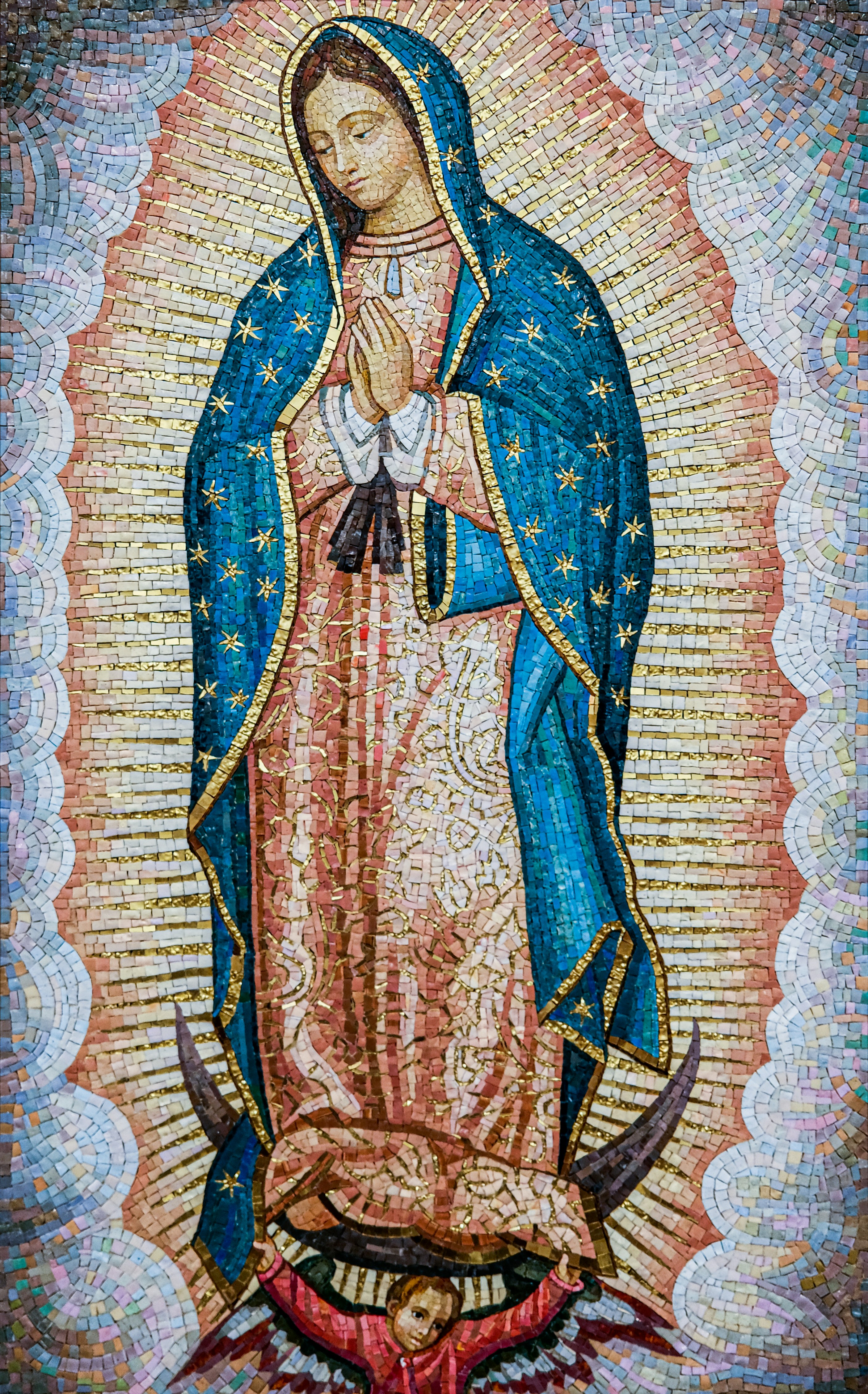
Today’s Gospel tells us how Mary became the mother of Jesus: “Then the angel said to her, “Do not be afraid, Mary, for you have found favor with God. Behold, you will conceive in your womb and bear a son, and you shall name him Jesus.” She then becomes the new Ark of the Covenant.
When the Blessed Virgin Mary appeared to Juan Diego, a poor farmer in Mexico in December of 1531, we have a sense of the same image described in the first reading from the Book of Revelation: “A great sign appeared in the sky, a woman clothed with the sun, with the moon under her feet, and on her head a crown of twelve stars.” Our Lady of Guadalupe, whose feast day we celebrate today, left her image on Juan Diego’s tilma.
On it, she is surrounded by the rays of the sun and stands on the moon. Her hands are clasped in prayer. She wears a rose-colored tunic with a blue cloak dazzled with stars. Her eyes are cast down, showing humility. She is pictured with a black ribbon around her belly meaning she’s with child. Her complexion matches that of the mestizos, the indigenous people. Juan Diego was very humbled to see her, as Our Lady appeared to him and spoke in his native language. (The image on the tilma can currently be seen at the Basilica of Our Lady of Guadalupe in Mexico City.)
She appeared in a place called Tepeyac Hill, on the land where a pagan Aztec temple had once been. Word spread about her miraculous appearances to Juan Diego and about the tilma. That led to the conversion of millions of indigenous people. Even today more and more people around the world love Our Lady of Guadalupe. Her words to Juan Diego are so pure, “Am I not here, I who am your mother?”
There have been many apparitions of Mary around the world. She has visited in various ways in different countries. It’s easy to have a favorite, or one that resonates more with us. Just as Our Lady of Guadalupe appeared in a specific manner for Juan Diego, she relates to each of us in a personal way as well. No matter our country of origin, we can love our Mother Mary as our own.
Even if our own birth mother has passed away, we will always have Mary as our Blessed Mother. If we never knew our mother or did not have a close relationship with her, we can get close to our loving Mother Mary. She is right there with us as we recite the rosary.
Because of Mary’s belief in the angel Gabriel whom God sent to her, we have an eternal Mother in Heaven and with us spiritually on this earth. “Blessed are you who believed that what was spoken to you by the Lord would be fulfilled.” (Luke 1:45)
Our Lady of Guadalupe, pray for us!
El Evangelio de hoy nos relata cómo María se convirtió en la madre de Jesús: “El ángel le dijo: ‘No temas, María, porque has hallado gracia ante Dios. Vas a concebir y a dar a luz un hijo y le pondrás por nombre Jesús.’” Ella se convierte entonces en la nueva Arca de la Alianza.
Cuando la Santísima Virgen María se apareció a Juan Diego, un campesino pobre de México, en diciembre de 1531, nos hace reflexionar sobre la misma imagen descrita en la primera lectura del Apocalipsis: “Apareció entonces en el cielo una figura prodigiosa: una mujer envuelta por el sol, con la luna bajo sus pies y con una corona de doce estrellas en la cabeza.” Nuestra Señora de Guadalupe, cuya fiesta celebramos hoy, dejó su imagen en la tilma de Juan Diego.
En ella, la Virgen está rodeada por los rayos del sol y parada encima de la luna. Sus manos están unidas en oración. Está vestida de una túnica rosa con un manto azul deslumbrado por estrellas. Está mirando para abajo, mostrando humildad. Se la representa con una cinta negra alrededor del vientre, lo que significa que está encinta. El color de su piel coincide con el de los mestizos, los indígenas. Juan Diego se sintió muy humilde al verla, ya que Nuestra Señora se le apareció y le habló en su lengua materna. (La imagen en la tilma se puede ver actualmente en la Basílica de Nuestra Señora de Guadalupe en la Ciudad de México).
Se le apareció en un lugar llamado el cerro del Tepeyac, en el terreno donde antiguamente había un templo pagano azteca. Se corrió la voz sobre sus apariciones milagrosas a Juan Diego y sobre la tilma. Esto llevó a la conversión de millones de indígenas. Incluso hoy en día, cada vez más personas en todo el mundo aman a Nuestra Señora de Guadalupe. Sus palabras a Juan Diego son tan puras: “¿No estoy yo aquí, yo que soy tu Madre?”
Maria ha aparecido muchas veces en muchas partes del mundo. Ha visitado diversos países de diversas formas. Es fácil tener una aparición favorita o una que nos resuene más. Así como Nuestra Señora de Guadalupe se apareció de una manera específica a Juan Diego, también se relaciona con cada uno de nosotros de forma personal. Sin importar nuestro país de origen, podemos amar a la Madre María como nuestra propia madre.
Aunque nuestra madre biológica haya fallecido, siempre tendremos a María como nuestra Santísima Madre. Si nunca conocimos a nuestra madre o no tuvimos una relación cercana con ella, podemos acercarnos a nuestra querida Madre María. Ella está ahí con nosotros mientras rezamos el rosario.
Gracias a que María creyó en las palabras del ángel Gabriel, enviado por Dios, tenemos una Madre eterna en el Cielo y con nosotros espiritualmente aquí en esta tierra. “Dichosa tú, que has creído, porque se cumplirá cuanto te fue anunciado de parte del Señor”.
¡Nuestra Señora de Guadalupe, ruega por nosotros!
 Christine Arata is a San Francisco, California native. She lives a few blocks away from the ocean and a park. She finds nature inspiring. Her cat brings her comfort. She loves being creative not only with her writing but with almost everything, including her home cooking. Her studies in the Catholic faith are ongoing. In 2019, when she discovered St. Hildegard of Bingen was underrepresented by Catholics, she found a purpose. Her latest website, St. Hildegard’s Wisdom features blog posts about all of that: https://sthildegardswisdom.com
Feature Image Credit: Grant Whitty, unsplash.com/photos/a-mosaic-of-the-virgin-mary-of-guadalupe-9CiOeQQ7m9Y
The views and opinions expressed in the Inspiration Daily blog are solely those of the original authors and contributors. These views and opinions do not necessarily represent those of Diocesan, the Diocesan staff, or other contributors to this blog.
 1-800-994-9817