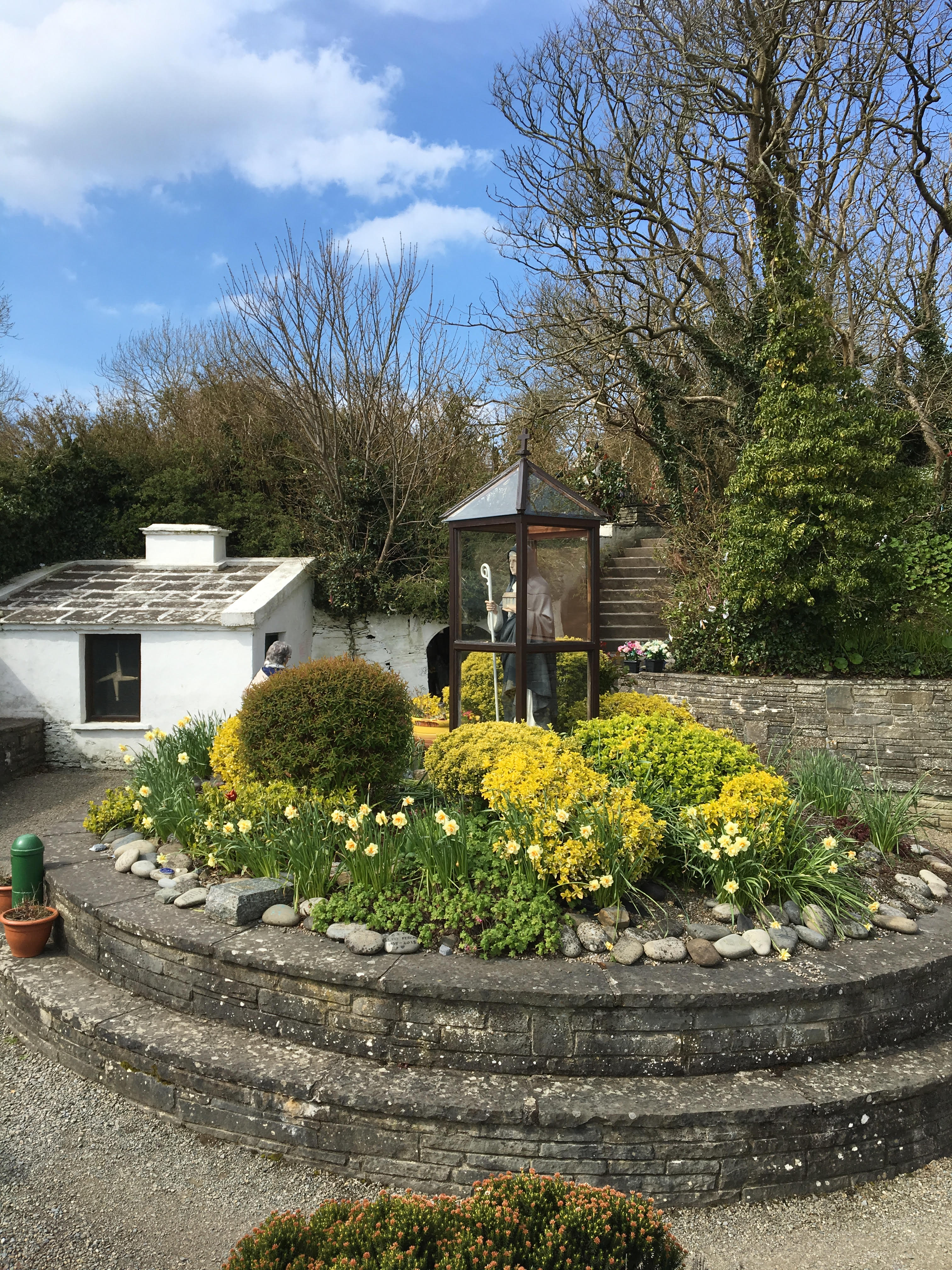
I love St Brigid! An abbess and the only female Patron Saint of Ireland, she is also known as “Mary of the Gael” or the “Mother Saint of Ireland.” Founder of one of the first monasteries in Ireland and whose relics shared a triple tomb, with St. Patrick and St. Columbkille in Downpatrick, Northern Ireland.
The fact that she was born in 453 and died in 523 at 70 years old was a miracle itself for the fifth century. Her father was a Pagan, a Leinster Chieftain who sold her Christian mother and baby Brigid into slavery to a Druid. She was returned to her father when she was ten years old where Brigid’s charitable nature soon had her donating her father’s possessions to any who needed them. Her father was not amused and tried selling Brigid to the King of Leinster. While she was there, she gave the King’s jeweled sword to a beggar. The King of Leinster, a Christian, convinced her Father to grant her freedom saying “Her merit before God is greater than ours.” This same King granted her land to build Kildare Abbey (Cill-Dara or Church of the Oak) after performing her first miracle by asking him to give her as much land as her cloak would cover which billowed out over several acres.
It’s been almost four years since I was in Ireland with a wonderful group from St. Anthony’s in Grand Rapids. Visiting one of St Brigid’s wells was not on our itinerary, but our driver and tour guide happily obliged. This well, south of the Cliffs of Moher, left me awestruck as I comprehended what I was seeing. The Druid tree or fairy tree is adorned with bits of paper and ribbon filled with prayers and intentions. The well and grotto are filled with photos and rosaries of loved ones in need of healing and the random clotheslines are filled with billowing sheets blowing into the small cemetery behind it. This little roadside gem was a homage of her life from Pagan roots to Druid slave, from Abbess to Saint. This is a timeless place, a natural shrine of devotion and faith of her culture.
From spiritual obscurity to beloved Saint, Brigid of Kildare continues to comfort and inspire all of us on our personal spiritual journeys.
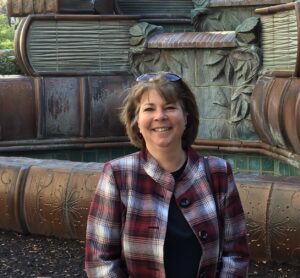 Kay Kunz is the Accounts Manager at Diocesan. She is a mother of two and grandmother of five. Living on her family’s centennial farm surrounded by nature, creatures great and small, wild and tame, Kay and her husband are in perpetual restoration mode. When she is not crunching numbers or helping churches with bookkeeping issues, you’ll more than likely find her curled up with a book and a cup of coffee. Inspired by St. Brigid of Kildare, not just because she is the patron saint of chicken farmers and turning water into beer, but her simple pastoral life of finding peace in nature.
Feature Image Credit: By Author
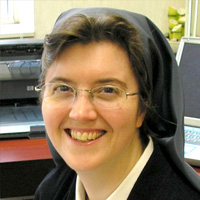 Kathryn James Hermes, FSP, is the author of the newly released title
 Emily Jaminet is a Catholic author, speaker, radio personality, wife, and mother of seven children. She earned a bachelor’s degree in mental health and human services from the Franciscan University of Steubenville. She is the co-founder of

 Leslie Sholly is a Catholic, Southern wife and mother of five, living in her hometown, Knoxville, Tennessee. She graduated from Georgetown University with an English major and Theology minor. She blogs at
 Deacon Dan Schneider is a retired general manager of industrial distributors. He and his wife Vicki have been married for over 50 years. They are the parents of eight children and thirty grandchildren. He has a degree in Family Life Education from Spring Arbor University. He was ordained a Permanent Deacon in 2002. He has a passion for working with engaged and married couples and his main ministry has been preparing couples for marriage.
 Mike Karpus is a regular guy. He grew up in Michigan’s Upper Peninsula, graduated from Michigan State University and works as an editor. He is married to a Catholic school principal, raised two daughters who became Catholic school teachers at points in their careers, and now relishes his two grandchildren, including the 3-year-old who teaches him what the colors of Father’s chasubles mean. He has served on a Catholic School board, a pastoral council and a parish stewardship committee. He currently is a lector at Mass, a Knight of Columbus, Adult Faith Formation Committee member and a board member of the local Habitat for Humanity organization. But mostly he’s a regular guy.
 Kathryn Mulderink, MA, is married to Robert, Station Manager for Holy Family Radio. Together they have seven children (including Father Rob), and four grandchildren. She is President of the local community of Secular Discalced Carmelites and has published five books and many articles. Over the last 30 years, she has worked as a teacher, headmistress, catechist, Pastoral Associate, and DRE, and as a writer and voice talent for Catholic Radio. Currently, she serves the Church by writing and speaking, and by collaborating with various parishes and to lead others to encounter Christ and engage their faith. Her website is
 David Dashiell is a freelance writer, editor, and proofreader based in the Pittsburgh, Pennsylvania area. His writing has been featured in Crisis Magazine and The Imaginative Conservative, and his editing is done for a variety of publishers, such as Sophia Institute and Scepter. He can be reached at
 Susan Ciancio has a BA in psychology and a BA in sociology from the University of Notre Dame, with an MA in liberal studies from Indiana University. For the past 17 years, she has worked as a professional editor and writer, editing both fiction and nonfiction books, magazine articles, blogs, educational lessons, professional materials and website content. Eleven of those years have been in the pro-life sector. Currently Susan freelances and writes weekly for HLI, edits for American Life League, and is the editor of Celebrate Life Magazine. She also serves as executive editor for the Culture of Life Studies Program-an educational nonprofit program for K-12 students.
 Dakota currently lives in Denver, CO and teaches English Language Development and Spanish to high schoolers. She is married to the love of her life, Ralph. In her spare time, she reads, goes to breweries, and watches baseball. Dakota’s favorite saints are St. John Paul II (how could it not be?) and St. José Luis Sánchez del Río. She is passionate about her faith and considers herself blessed at any opportunity to share that faith with others. Check out more of her writing at
 1-800-994-9817